“AI translation” usually means one step: text goes to a model, text comes back. That works until the file has tags, or a glossary, or a translation memory, or a client who notices that 1,000.50 became 1.000,50 in a language that does not do that.
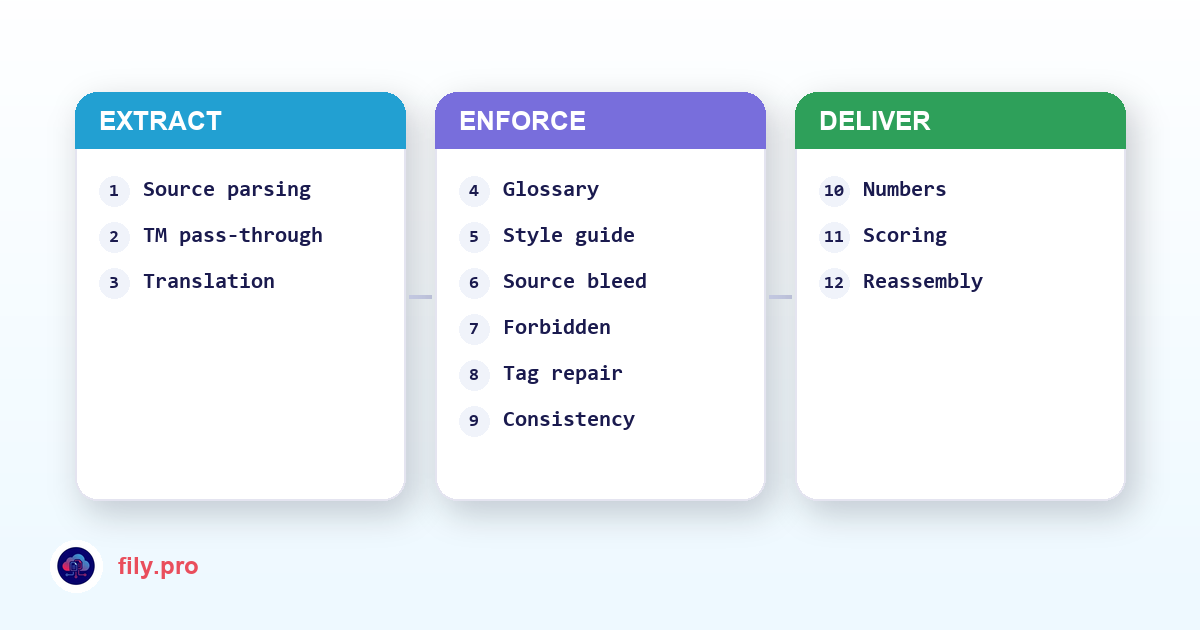
Fily runs twelve steps in three phases. Every one has a name, an owner and a measurable check, and every one appears in the report attached to your delivery. Here is the whole journey.
Phase 1 — Extract (steps 1–3)
- 1. Source parsing — the file is read with a codec built for its actual format, identifying tags, locked segments and everything that must not be touched.
- 2. TM match pass-through — 100% and 101% matches bypass the AI byte for byte. They are not re-translated, not re-worded, and not billed.
- 3. Segment translation — what remains goes to a frontier model with the surrounding context, your instructions and cached prompts for consistency across the document.
Phase 2 — Enforce (steps 4–9)
This is the phase that separates a pipeline from a prompt. The translation exists; now it has to obey your rules.
- 4. Glossary enforcement — preferred terms are inserted into the target, not merely flagged for someone else to fix.
- 5. Style guide application — voice, register and punctuation conventions for that client and project.
- 6. No-source-bleed check — catches chunks that slipped through untranslated, the failure that is embarrassing precisely because it is so obvious once delivered.
- 7. Forbidden term replacement — brand-prohibited words rewritten to approved equivalents.
- 8. Tag count repair — inline tags realigned and verified so the target tool accepts the file on import.
- 9. Consistency check — the same source span gets the same target across the whole document.
Phase 3 — Deliver (steps 10–12)
- 10. Number and date normalization — decimal separators, date formats and currencies converted per locale, which is where a surprising share of real complaints come from.
- 11. Quality scoring — a score per segment and per pipeline step, visible in the report.
- 12. Bilingual reassembly — the file is repacked in its original format, tags intact, ready to deliver.
Why the order matters
Each step assumes the previous ones ran. Tag repair happens after terminology enforcement because enforcement edits the target and can disturb tags. Consistency runs after replacement so it compares final text, not drafts. Reassembly is last because everything before it may still change the target. A pipeline is not a checklist you can shuffle.
And you get the receipt
The QA report attached to every delivery shows what fired, what passed and what was flagged: glossary hits and misses, forbidden terms replaced, tag differences per segment, which segments passed through from TM at zero cost, and the score per step. Your reviewer reads that instead of four thousand segments — and your client gets a document that answers “how do you know this is right?” without a meeting.
Want this in your workflow? Try Fily with one file — no card, no demo form.