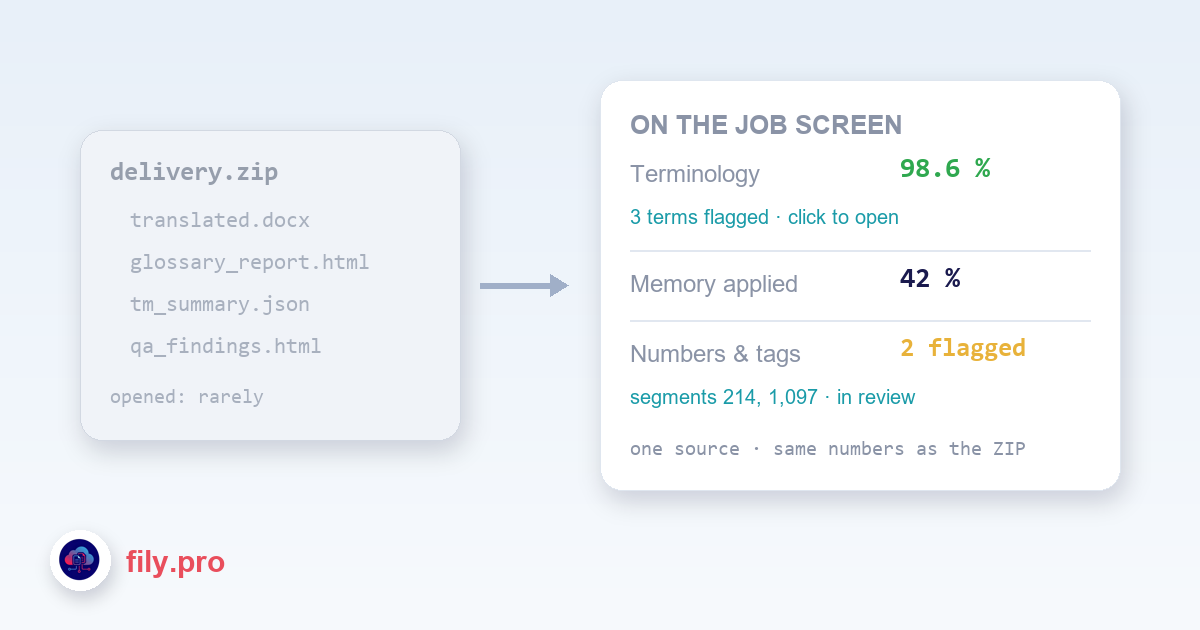
Every Fily delivery ships with machine QA reports: how well the glossary was applied, how much came from your translation memory, whether every number and formatting tag survived the trip. They have been in the delivery package for months. Honest question: when did you last unzip a delivery to read a report?
A report nobody opens is decoration. So we moved the numbers to where people actually look.
On the job screen now
- Glossary compliance with the detail that makes it actionable — which terms, in which segments — not just a percentage with nowhere to click.
- A translation memory summary: how much of this job came from memory you already owned.
- The exact segments where a memory match dropped a number or a tag, listed by name instead of buried in a log.
- For a batch, a project-level summary across all files — one card, not fifty.
And inside the review
Reviewers now see the engine’s findings inside the review screen, next to the checks the browser runs — and that includes batch reviews, which used to show only the browser’s side. The machine flags and the human decides, which is our whole thesis; but the human can only decide about a flag they can see.
The embarrassing part
Putting numbers on a screen means people look at them, starting with us. In the process we found that the two glossary reports inside the delivery package could disagree with each other; that a “verified” counter had been reading zero forever — and was not even counting the glossary; that the memory summary card sometimes said 0 and in one path never reached the screen at all; and that the tag checker was counting tag IDs as if they were numbers from your document, raising alarms about “lost numbers” that were never in the text.
All of it is fixed, and every card now reads from the same source the delivery reports are built from — one set of numbers, however you look at them. The lesson we keep re-learning: a metric nobody watches quietly rots. Publishing it is also how it gets audited.
Open any recent job and look at the Terminology and Memory cards. If a number surprises you, click it — it now takes you to the segments behind it, which is the entire point.
Want this in your workflow? Try Fily with one file — no card, no demo form.