The audio review editor did what you would expect: play the recording, correct the transcript segment by segment, click Finalize. A toast confirmed the review was complete.
The toast was telling the truth about the review and lying about everything downstream. Finalize wrote a corrected transcript to storage, and nothing on the other side read it. The deliverable — the document your client receives — was still the one built before any human touched the file.
The shape of this failure
It is worth naming the pattern, because we have now hit it twice. A review step that saves its work somewhere nobody consumes produces the most expensive kind of bug: everything looks successful. The reviewer's time is spent, the confirmation appears, the client gets a file. Nothing in the system reports an error, because from each component's point of view nothing went wrong.
The only defence is to test from the outside in — type something into the editor that could not possibly appear by accident, run the job to delivery, and open the file that comes out. We do that now as a matter of course, on this pipeline and the subtitle one.
What Finalize does now
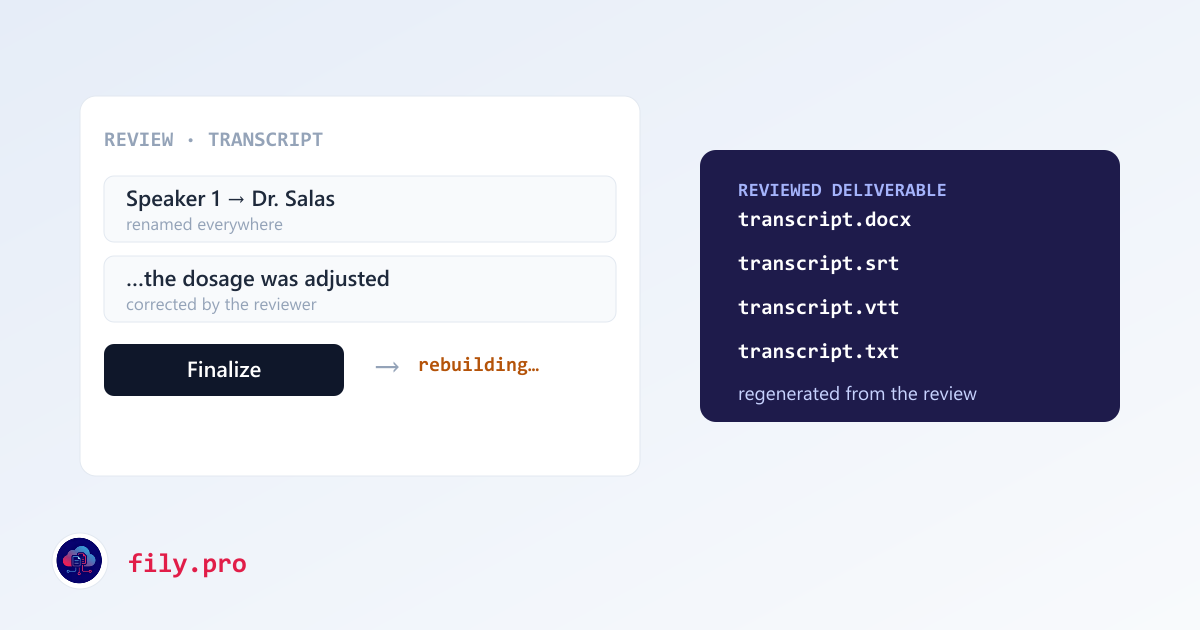
Approving the review queues a rebuild, and the rebuild regenerates the whole deliverable from the corrected transcript: the bilingual document, plus SRT, WebVTT and plain text, packaged as one download. The editor shows the rebuild running, disables Finalize while it works, and offers the reviewed package when it lands — or a clear error if something failed, instead of a success message that was never true.
Speakers get names
Diarization labels voices as Speaker 1, Speaker 2, Speaker 3. Nobody wants that in a deposition transcript or a focus-group report. You can now rename every speaker once, from a dialog, and the names propagate through the editor and into every regenerated file. The underlying labels are kept as identity, so a rename is a rename — not a find-and-replace that catches the word in the middle of a sentence.
And the transcript follows the audio
The editor now highlights the word being spoken as the recording plays, and clicking any word seeks the audio to it. For an hour-long recording that is the difference between reviewing a transcript and hunting through one — you hear something wrong, you are already looking at it.
Renaming speakers and correcting a word are the two things every transcript reviewer does, and until this week only one of them reached the file we delivered. Both do now.
Want this in your workflow? Try Fily with one file — no card, no demo form.