Ask a translation tool for Spanish and most of them will give you Spanish. One Spanish. The dropdown might even say es-MX, but underneath it is the same model call with a different label attached.
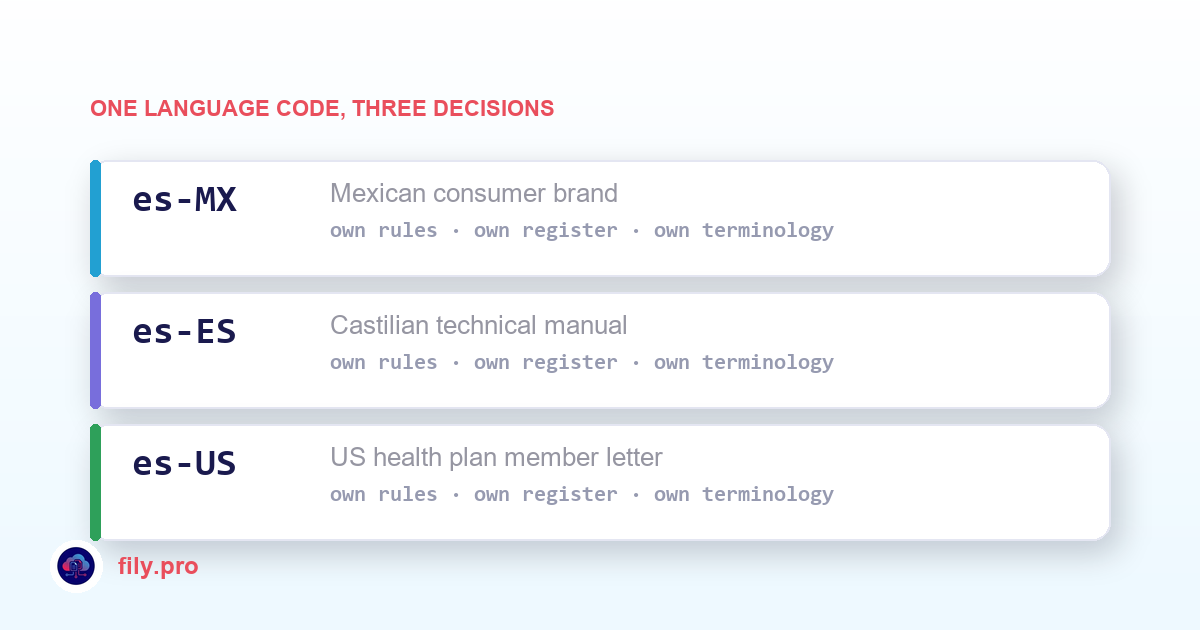
That works until it does not. A US health plan writing to its Spanish-speaking members does not sound like a Mexican consumer brand, which does not sound like a Castilian technical manual. Same language, three different sets of decisions — vocabulary, register, formality, how you address the reader at all.
The rules are per pair, not per language
Every language pair has its own rule set: how the reader is addressed, punctuation conventions, number and date formats, spacing, the terms that are correct in one variant and wrong in another. Those rules ship with the pipeline for the pairs we run in production, and they are applied as an enforcement step — not as a suggestion in the prompt.
That distinction matters more than it sounds. A locale instruction inside a prompt is a hope. A locale rule applied after translation, and verified, is a guarantee — and it can be inspected in the QA report.
And your rules override ours
Defaults are a starting point, not a policy. Rules can be overridden per organization and per client, and those overrides win over the shipped defaults. If your health plan says “afiliado” and never “miembro”, that is not a note in a style guide PDF that a linguist may or may not have read. It is enforced on every job for that client, in that pair, forever.
This is the same cascade that carries your glossary: organization, then client, then sub-client or brand, then the individual job. Locale variants live inside it, which is how one organization can serve a Mexican brand and a US health plan from the same account without their terminology ever meeting.
The failure this prevents
The expensive version of this problem is not a wrong word. It is a whole delivery in the wrong variant — a campaign for the US market that reads as European Spanish, or a member letter that uses the register of a marketing brochure. Nobody catches it in QA because nothing is technically incorrect. The client catches it, and the client is not pleased.
So we treat the locale as part of the job definition, not as a suffix on the language code.
Want this in your workflow? Try Fily with one file — no card, no demo form.