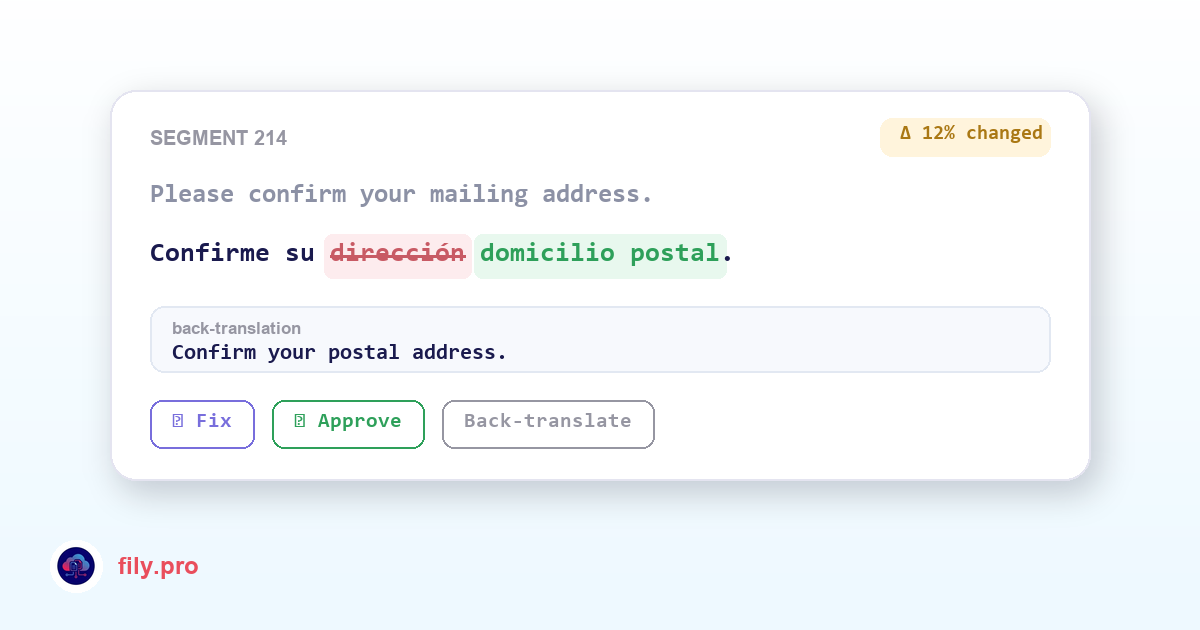
Our pitch is that you should not have to sit in a CAT tool to get a translation. The obvious objection follows immediately: then how do I check the work?
Every job opens in a browser review editor. Nothing to install, no license, no project setup. Invisible workflow does not mean opaque — it means the inspection is there when you want it, instead of being the price of admission.
A diff, not a wall of segments
The editor shows a word-level diff against the file you uploaded: changed words highlighted, with a real percentage of change per segment. A reviewer can sort by how much actually moved and read the twelve segments that matter instead of scrolling through four thousand that did not.
That single decision is what turns reviewing a file into reviewing the decisions.
Cross-file consistency in one click
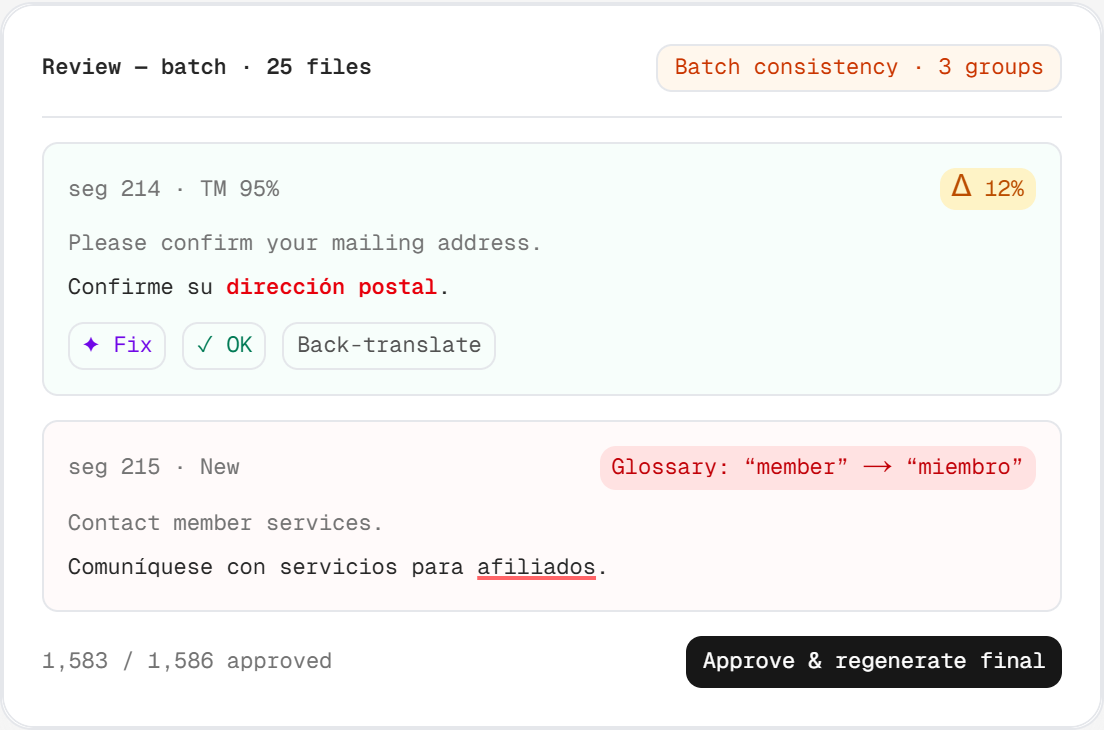
In a batch, the same source sentence used to come back translated two or three different ways across different files — and the only defense was a human noticing. A consistency pass now flags every span with divergent targets across the whole batch and unifies them in one click, with inline tags left untouched.
Help for the languages you do not read
- Per-segment back-translation — see what the target actually says, in your language, before you approve it.
- Ask AI to review a specific segment, with the reasoning shown.
- Per-segment autofix and spellcheck for the mechanical corrections.
- Glossary and forbidden-term flags shown inline, where the decision is being made.
The back-translation solves a problem every project manager knows: signing off on a delivery in a language nobody on the team reads. Without it, you subcontract someone just to approve.
A gate before delivery
Turn on hold for review and nothing reaches the client until a reviewer approves. The final file is then regenerated from the approved edits — run back through the pipeline, not patched afterwards — so what ships is exactly what was signed off.
Your client's editors, without opening the kitchen
If you are an LSP, your end client often wants to review — and you do not want to give them a view of your operation. Invite them with a reviewer role and they see only the jobs a project manager assigns to them: never your other clients, your volumes, or your configuration. Their approved edits feed your translation memory like any other correction.
Built for the batch, not the demo
A real batch is fifty files and sixty thousand words in a single review. The editor renders a window of that at a time so the browser stays responsive — while bulk actions still operate over the entire filtered set, not just the rows you can see. That distinction sounds like a detail until you approve 1,586 segments and discover it applied to 150.
And then the review pays for three other things
This is the part that surprises people, and it is the reason we treat review as infrastructure rather than as a checkbox at the end. Everything a reviewer does is recorded as structured evidence, and that evidence feeds three separate outcomes:
- Effort reporting — segments touched, words changed and estimated time per reviewer, so you can pay people for the work the AI did not do.
- Quality scoring — what escaped automation, weighted by severity, per linguist and per pipeline configuration.
- Your Golden TM — every approved correction is promoted into your organization's memory, so the same issue is not reviewed again next month, and those segments bill at zero.
And the record is precise about what kind of work it was. Typing a correction by hand, clicking accept on a suggestion, and applying one consistency decision across a batch are three different amounts of effort — they are counted separately. Corrections the pipeline made automatically are machine work and are excluded from every human number.
So the review stage is not a cost center bolted onto the end of automation. It is where the automation learns, where the quality number comes from, and where the invoice gets its evidence.
Want this in your workflow? Try Fily with one file — no card, no demo form.