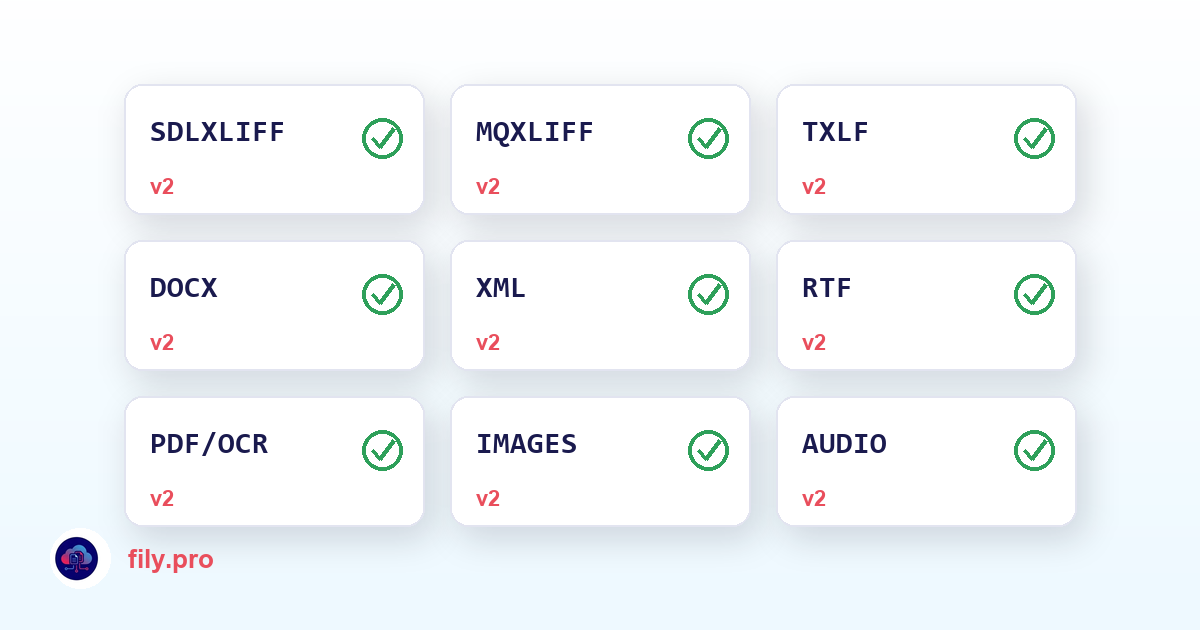
May was the month the v2 core went everywhere. Every format pipeline now runs on the same 12-step engine — one set of guarantees, enforced identically whether you upload a Trados package or a scanned fax.
All pipelines on the v2 core
SDLXLIFF, MQXLIFF, TXLF, XML, DOCX, RTF, images, scanned PDFs, audio — all migrated to the v2 pipeline core. Same phases, same validators, same QA report structure. If you process mixed batches, every file now comes back with the same auditable trail.
Glossary enforcement that fixes, in three layers
Glossary autofix now runs three passes — a deterministic matcher, a lemma-aware pass for inflected languages, and a focused AI micro-pass for the stubborn cases — each validating tags afterwards and rolling itself back if a repair would break the file. Detection tools flag problems; this fixes them, safely.
Client rules, five levels deep
Organization → client → sub-client → language pair → job: configuration now cascades with deep merge at every level. Set the rule once where it belongs and every future job inherits it. This is how one PM manages forty end-clients without re-attaching glossaries to anything.
Tracked changes that survive translation
The delta-aware DOCX pipeline shipped: English original + English redlines + existing Spanish v1 in, Spanish v2 out with the equivalent tracked changes applied. We wrote up the full story on the blog — as far as we know, no other tool does this.
Smaller but real
- Hard TM respect for Phrase TXLF: locked and 100/101 segments are never sent to the AI, byte-for-byte.
- Bilingual RTF for Trados and Wordfast Classic joined the format list.
- Per-segment quality scoring now feeds the report on every pipeline, not just a few.
Want this in your workflow? Try Fily with one file — no card, no demo form.