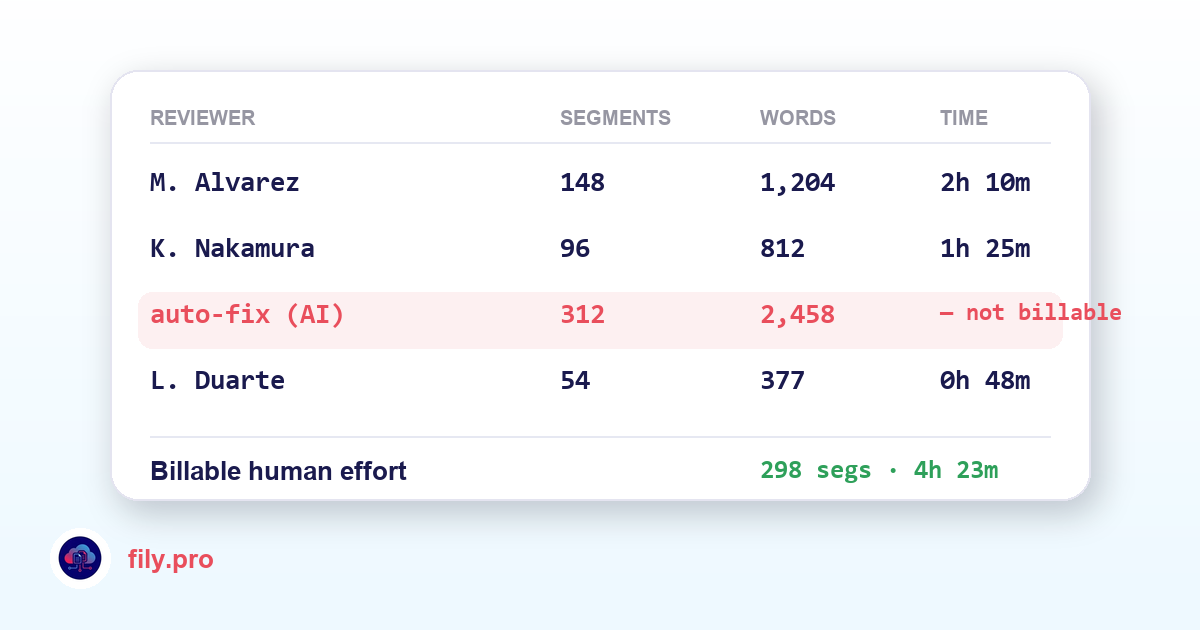
Here is a problem that only exists once AI is genuinely good: how do you pay the human who reviews its output?
Per word is wrong — most words needed no work at all. Per hour is unverifiable. Per job is a guess. Every LSP running an AI-first workflow is negotiating this in spreadsheets right now, and the numbers in those spreadsheets are invented.
Measure the intervention, not the volume
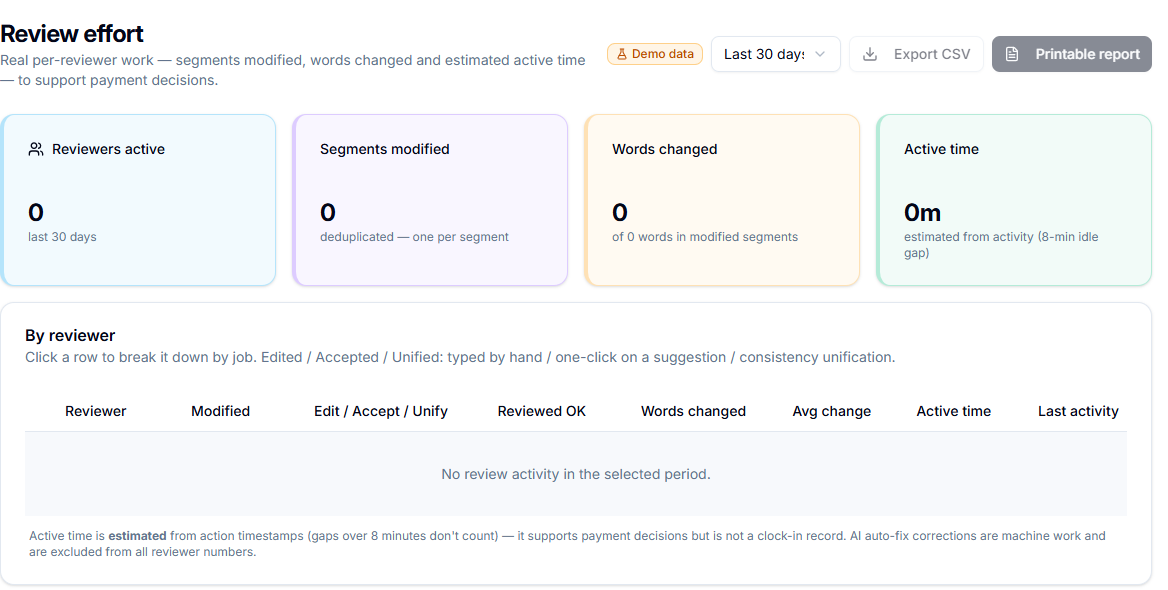
Fily now reports, for every reviewer and every job: how many segments they actually modified, how many words changed — measured as a real diff, not a flag — the average size of their edits, and an estimate of active time.
Not every human action is the same work
This is the part we think matters most, and it is the reason a single “segments touched” number is misleading. The report separates three kinds of human action:
- Edited — the reviewer typed a correction by hand. The most expensive kind of attention.
- Accepted — one click on a suggestion the system offered. Real judgement, far less work.
- Unified — a consistency decision applied across the batch in one action.
Paying those three at the same rate is how a reviewer who unified one term across fifty files ends up billing like someone who rewrote fifty segments — or the reverse, which is worse, because that is the person who quits.
The rule that keeps the number honest
Work the AI did is not billable human work. When our pipeline auto-corrects a glossary term, that correction is machine work and is excluded from every reviewer number on the page. It is reported separately, so you can see how much the automation absorbed — without confusing it with what a person decided.
Segments are also deduplicated: one entry per segment, no matter how many times it was opened. Otherwise the metric rewards indecision.
Built for the day you have to pay someone
- Totals for the period, and a row per reviewer that expands job by job.
- CSV export — one row per reviewer and per job, shaped for payroll.
- A printable report showing the before and after of every human change: the evidence behind the invoice, in your branding.
- Scoped by project, job, reviewer or period — whatever your billing cycle looks like.
Two things we will say plainly
Active time is estimated from the timestamps of the actions themselves, grouping them into working sessions and ignoring gaps over eight minutes. It supports a payment decision; it is not a clock-in record, and we would rather describe it accurately than oversell it.
And review activity recorded before we started attributing authorship appears as unattributed rather than assigned to someone. We are not going to invent an author on a record that will be used to pay a person.
If you run reviewers on top of AI output, this is the number your margin depends on. Ask your Account Manager to walk through your last cycle.
Want this in your workflow? Try Fily with one file — no card, no demo form.