A forty-thousand-word job with a Friday deadline has a bottleneck that no amount of pipeline speed fixes: the review at the end was one person’s job. You could ask three reviewers to “coordinate”, which in practice meant a spreadsheet, a group chat, and two people editing the same paragraph in opposite directions.
Split the review by segment ranges
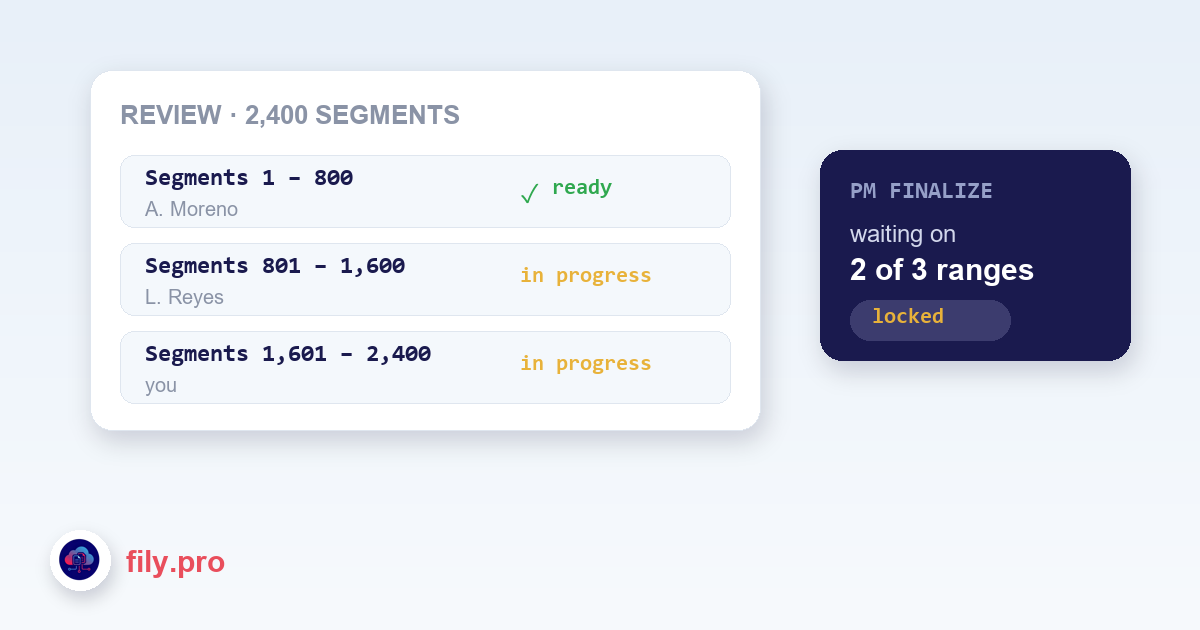
A review can now be divided among several reviewers by segment ranges: one takes 1–800, the next 801–1,600, and so on. Everyone opens the same review screen and works their own stretch. The boundary is enforced by the server, not by the interface politely hiding buttons — an edit outside your range is refused, full stop.
The segment numbering is frozen the moment the ranges are assigned, so “segments 801–1,600” means the same thing on every screen for the life of the job. There is also a numeric jump filter, because “go to segment 1,204” should be typing, not scrolling.
Nothing ships half-reviewed
Each reviewer marks their range ready when they are done. The project manager cannot finalize the job until every range is in — the gate is structural, not a checklist item someone can skip under deadline pressure. And if you never split a review, nothing changes: a job with no assignments behaves exactly as before, zero setup.
See it as they see it
Project managers also get “See as editor”: open the review exactly as a specific reviewer sees it — their range, their view, their pending work. Useful before assigning (“is this range reasonable?”) and indispensable mid-job, when a reviewer calls and you want to look at literally what they are looking at.
It composes with client editors
Reviewer accounts for your client’s own staff shipped in July: people who see only what is assigned to them, nothing else. The two features compose the way you would hope. Give your client’s in-country reviewer one range and keep the rest in-house; their “ready” reaches the project manager like anyone else’s, and they never see the parts of the job — or the platform — that are not theirs.
We built this because our customers’ jobs outgrew single-person review, not because a feature matrix demanded it. If your reviews have a bottleneck shaped like one very tired person, this is for them.
Want this in your workflow? Try Fily with one file — no card, no demo form.