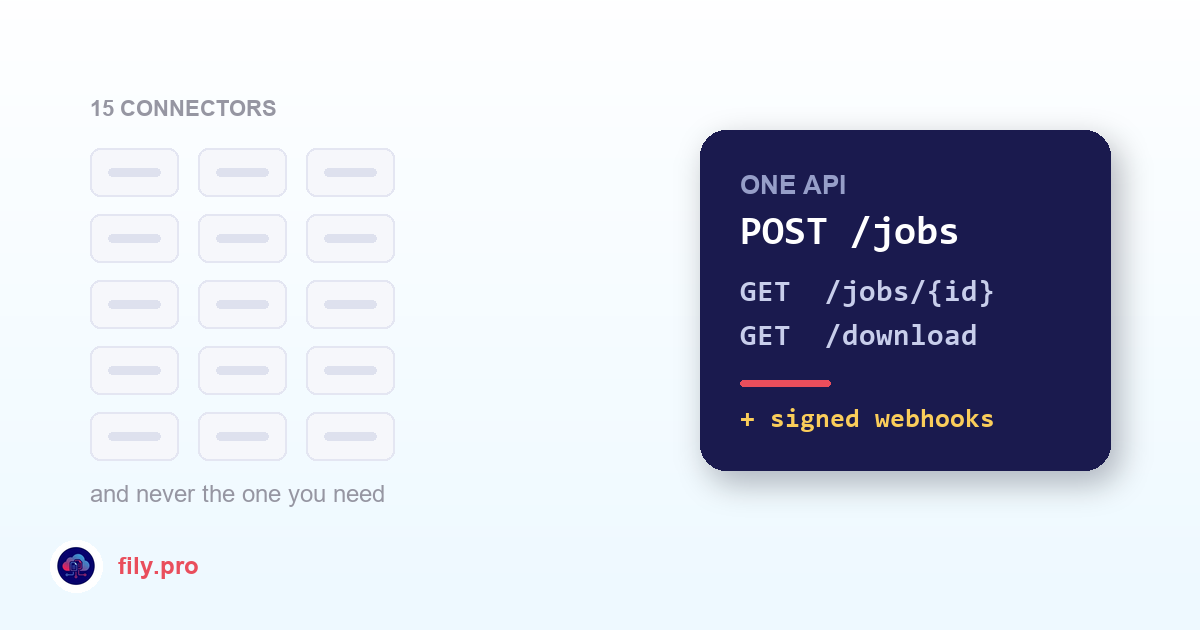
Every platform in this category advertises a connector count. Fifteen integrations. Twenty. A logo wall of content systems, repositories and design tools.
It is an impressive number and a fragile promise. Each connector is a separate piece of software that has to be maintained against somebody else’s API, and the one you need is reliably the sixteenth — the internal system, the old DAM, the workflow your operations team built in 2019 and still runs the business on.
So we built the door instead of the keys
Fily now has a public REST API. Submit a file, check its status, download the result, all from your own systems. One call uploads and creates the job. Your credit limits, permissions and configured pipelines apply exactly as they do in the dashboard — the API is not a side entrance with different rules, it delegates to the same handlers.
Keys are issued per organization, scoped, and revocable on the spot. Rate limits apply per key rather than per IP address, which matters the first time two of your systems call from behind the same gateway.
And webhooks, so you can stop polling
Register an endpoint and Fily posts to it when a job is created, finishes, fails, or a review is finalized. Three things make the difference between a webhook you can build on and one you have to babysit:
- Every delivery is signed, so you can verify it really came from us before acting on it.
- Failed deliveries are retried with exponential backoff — your endpoint can be down for a deploy without losing events.
- What never succeeds lands in a visible dead-letter log instead of disappearing.
The uncomfortable part
For a while our own website claimed API access on a plan where it did not exist yet. That was wrong, and we took it down before we shipped this. We would rather explain an awkward gap than have a customer discover it after signing.
It is worth saying because it is the standard we are asking you to hold us to — and because a competitor whose API documentation currently returns a 404 is not in a position to hold anyone to it.
The documentation is published and maintained. Ask your Account Manager for a key and point your system at it.
Want this in your workflow? Try Fily with one file — no card, no demo form.