Perspective · July 8, 2026 · 4 min read
Three branches, fifteen formats: what you can actually upload
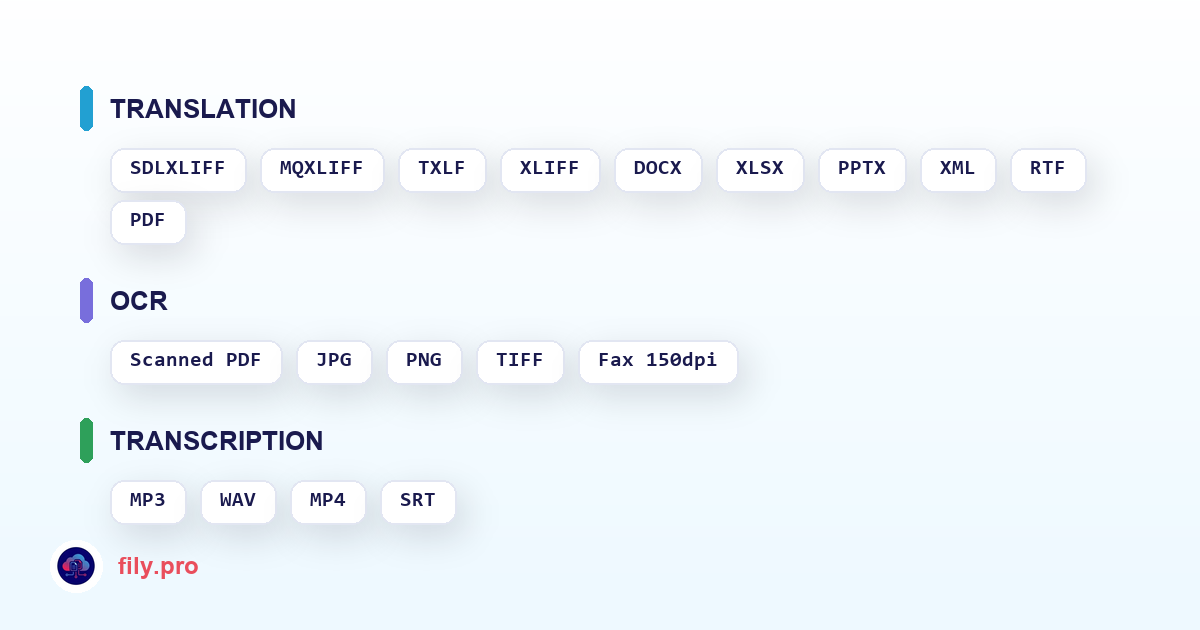
Most translation tools are built around one input and apologize for the rest. The apology usually sounds like “convert it to Word first.” That conversion is where formatting, tags and hours of someone's week go to die.
Fily is organized as three engineered branches that share one quality pipeline. Here is the whole map.
Branch 1 — Translation
- CAT bilinguals: Trados SDLXLIFF, memoQ MQXLIFF, Phrase TXLF, Wordfast TXLF, XLIFF 1.2 and 2.0, bilingual RTF — each with a dedicated codec, not generic XML handling.
- Office: DOCX, XLSX, PPTX — styles, tables, formulas and layouts survive the round trip.
- Structured content: custom XML and DITA-style schemas, where you decide what is translatable and what is passed through untouched.
- Native PDF: text extracted with layout awareness, returned as a document you can actually use.
Branch 2 — OCR
- Scanned PDFs, photos of documents, faxes down to roughly 150 DPI.
- JPG, PNG and TIFF images — including phone photos taken at an angle in bad light.
- Output as a searchable PDF or a DOCX with the layout reconstructed, images and stamps still in place.
Branch 3 — Transcription
- Audio and video: MP3, WAV, MP4 and the usual family — formats several competitors list as explicitly unsupported.
- SRT subtitles, with word-level timestamps and reading-speed awareness.
- Bilingual transcript delivery, diarized, inside your client's own branded template.
Why not one generic pipeline for everything
Because these three fail in completely different ways. A CAT file fails on tags. A scan fails on a page the OCR silently returns blank. Audio fails on crosstalk and a recorder across the room. A single generic pipeline handles the average case for all three and the hard case for none.
So the branches diverge where the failure modes diverge — and then converge on the same twelve QA steps, the same glossary enforcement, and the same report. Different roads, identical guarantees at the end.
And when your format is not on the list
We build pipelines. Tracked-changes DOCX round trips, transcripts in client templates, dual-backend OCR for impossible scans — all of those started as somebody's “that's not supported anywhere”. If your workflow is the awkward one, that is a conversation worth having rather than a reason to convert everything to Word.
Want this in your workflow? Try Fily with one file — no card, no demo form.