Ask a translation vendor about quality and you will get a percentage. Ours was 97%. It is a real number, measured on real production jobs — and on its own it does not tell you very much.
A pass rate treats every problem as equal. A missing comma and a mistranslated dosage both count as one. And on a 40,000-word job, a handful of serious errors disappear into a percentage that still looks excellent. Volume hides defects.
What we shipped
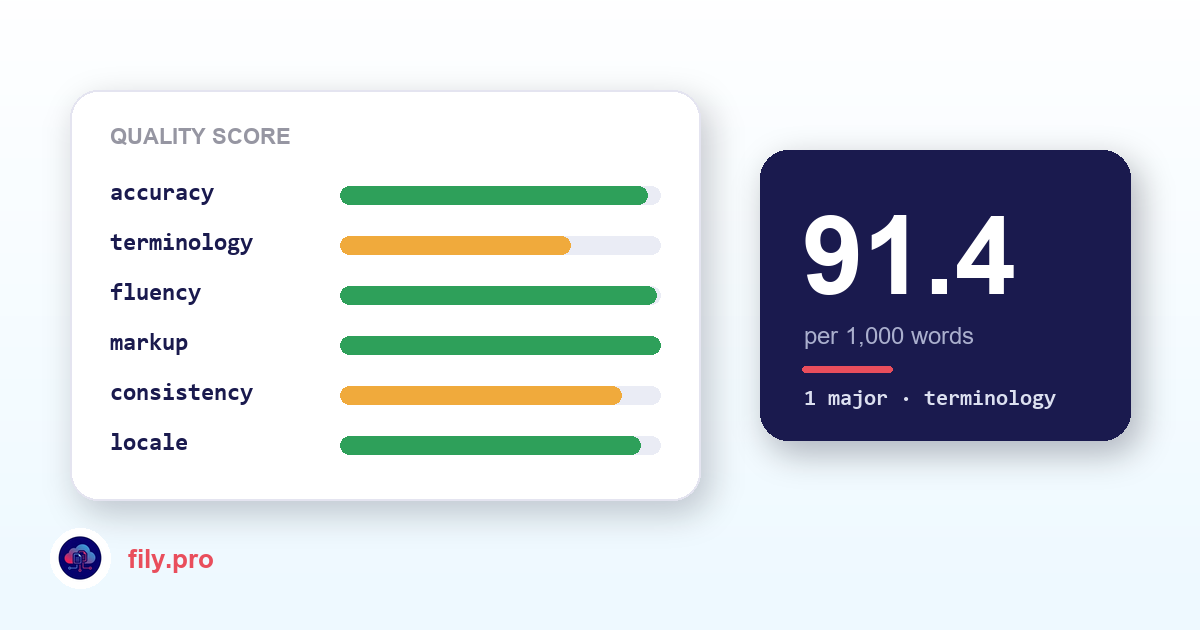
Quality scoring in the MQM tradition: every defect is classified on six dimensions — accuracy, terminology, fluency, markup, consistency, locale — and three severities: minor, major, critical. Each severity carries a weight, and the score is normalized per 1,000 words, so a long job cannot dilute its own errors.
The weights and the pass threshold are configurable per organization, because a marketing microsite and a hospital discharge form do not deserve the same tolerance for a terminology slip. Change the weight, and the score moves — it is your definition of quality, not ours.
The distinction almost nobody makes
Here is the part we think matters most. When our pipeline detects a glossary violation and rewrites it before delivery, that is not a defect you received. It is the pipeline doing its job. When a human reviewer had to step in and fix something, that is a defect that escaped automation — and it is the only kind that belongs in a quality score.
So we separate them. The score measures what escaped. What the pipeline caught and corrected is reported alongside it, as pipeline health. Two numbers that answer two different questions: how good was the delivery, and how much of that was automatic.
Most quality modules in this industry never make that separation — and several of them collect severities in one place and never connect them to any score at all.
Scorecards that tell you what to do
A number you cannot act on is trivia. The scoring rolls up two ways: by linguist, so you know who to send the next healthcare batch to, and by pipeline profile, so you know which configuration is letting defects through. In our own production data one profile scored two points below the rest — which is exactly the kind of signal that is invisible in an aggregate pass rate.
How to get it today
It is live in your dashboard under Quality score: the overall number, the breakdown by dimension and severity, and both scorecards — by linguist and by pipeline. It reads the reviews you have already done, so there is nothing to set up and no new step in your workflow. The same data is available through the API if you would rather pull it into your own reporting.
The one thing worth doing on day one: open the scoring policy and set the weights. The defaults are sensible, but only you know whether a terminology slip in your content is an inconvenience or an incident.
Want this in your workflow? Try Fily with one file — no card, no demo form.