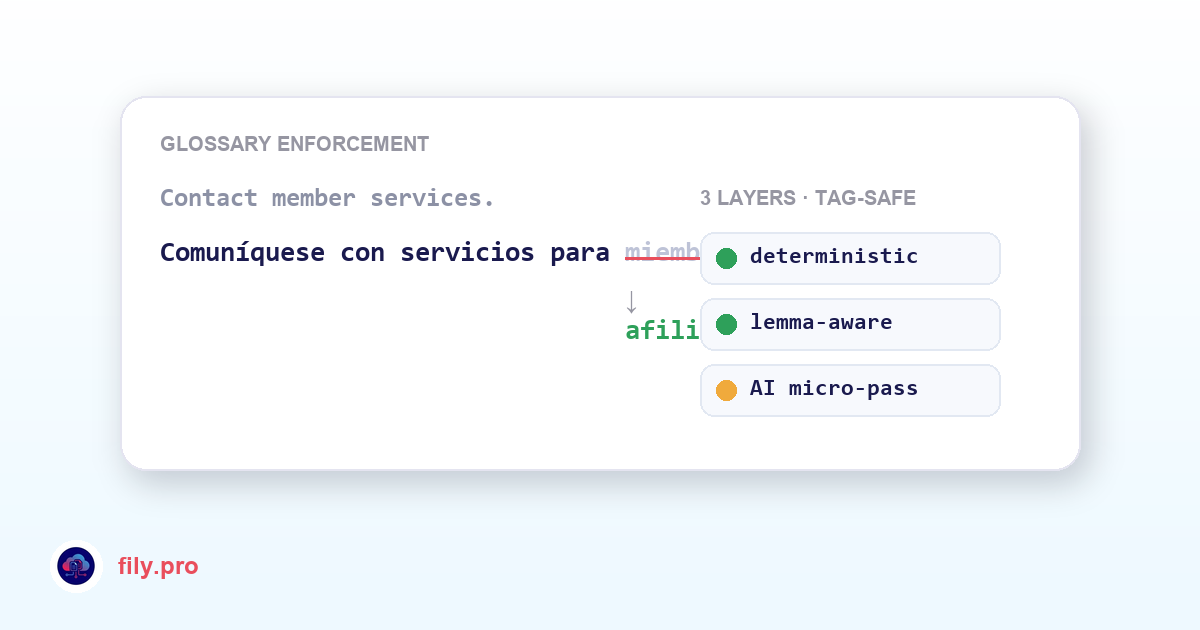
Open the QA panel of any translation tool and you will find a terminology check. It finds the violations, lists them, and colours them red. Then a human opens each one and fixes it by hand.
That is detection sold as quality assurance. If the software already knows the word is wrong, and already knows what the right word is, the list is a chore it decided to hand you.
Enforcement in three layers
Our glossary step rewrites the target. It runs in three passes, from cheapest and most certain to most careful:
- A deterministic matcher that finds and replaces exact terminology at speed, across the whole document at once.
- A lemma-aware pass for inflected languages, because “afiliado”, “afiliada” and “afiliados” are the same decision and a literal string match would miss two of them.
- A focused AI micro-pass for the cases the first two cannot resolve safely — where the fix requires rephrasing the sentence around the term, not swapping a word.
Every layer validates the inline tags after it edits, and rolls its own change back if the repair would damage the file. A glossary fix that breaks a Trados import is not a fix. This is why enforcement is safe to automate at all: the failure mode is “this one stays flagged for a human”, never “your file is corrupt”.
Forbidden terms are the other half
Preferred terminology says what to use. Forbidden terminology says what must never appear — a competitor's name, a deprecated product name, a phrase legal struck out last quarter. Those get replaced with the approved equivalent, and they are checked at more than one point in the pipeline, because a term that is correct at translation time can be reintroduced by a later step.
The cascade: set it once, where it belongs
Terminology inherits down four levels: your organization, then each client, then each sub-client or brand, then the individual job — with language-pair variants along the way, because Mexican Spanish, Castilian Spanish and US Spanish are not interchangeable and pretending they are is how you end up rewriting a campaign.
A project manager running forty end clients configures each rule at the level where it is true, and every future job picks up the right combination automatically. No re-attaching glossaries to jobs. No spreadsheet of which client uses which list.
And if you have no glossary yet
Most teams do not, or have one that stopped being maintained in 2023. Point our generator at documents you have already translated and it extracts a candidate glossary — terms, translations and how often they appear — for you to review and approve. Years of implicit decisions become an asset the pipeline can actually enforce.
Want this in your workflow? Try Fily with one file — no card, no demo form.