A public-sector healthcare client sent us an error report on two deliveries: thirty-four screenshots, each one a segment they had to fix. We grouped them by cause. The largest group was not terminology or style. It was what we did with fuzzy matches.
Two wrong answers
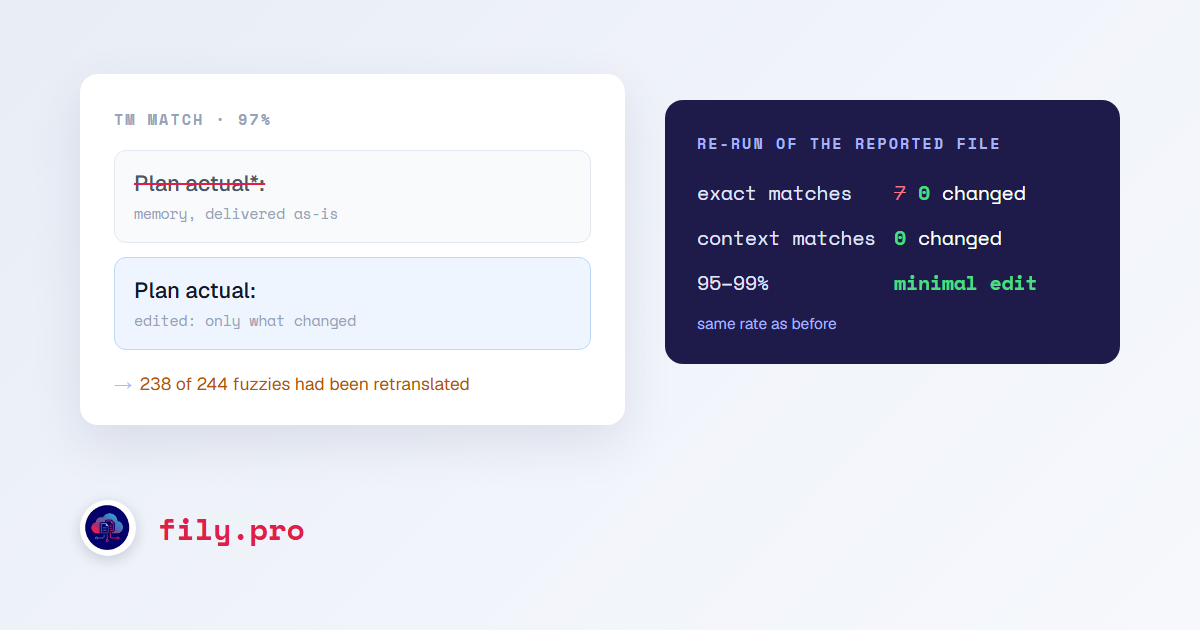
Matches from 95% to 99% were delivered exactly as the memory had them, including the part that no longer matched: a stray caret, an asterisk after a label, a placeholder in braces, last year’s date. Those are precisely the differences that make it 97% and not 100%.
Matches from 75% to 94% went the other way. They were sent for translation without the memory’s version, so the model translated them from scratch. In one batch, 238 of 244 fuzzy segments came back worded differently from the approved translation they were supposed to build on. Each was a reasonable sentence. Together they meant the reviewer was reconciling two voices in one document.
What a fuzzy match is for
A fuzzy match is a draft by a translator who already made your client’s choices: the register, the term for the agency, the way a heading is phrased. The right edit is the smallest one that makes it correct for the new source. Anything more throws those choices away, and anything less ships an error that the memory itself is pointing at.
What happens now
Every fuzzy match that has a target now travels to the model next to its source, with its score. The instruction is explicit: reuse the memory’s wording, and change only what the source changed. The 95–99% band is no longer delivered untouched; it is edited the same way, and usually that means a character or two.
We verified it by re-running one of the reported files: none of the 31 context matches or the 50 exact matches were touched, the caret and the asterisk were gone from the 95–99% band, the date was updated, and a 91% match kept the memory’s phrasing apart from the words that were actually new.
And the 100s stay 100s
The same delivery had seven exact matches that came back changed: five by glossary enforcement and two by the capitalization pass. Both now act only on segments we translated. An approved match is approved; the last time we wrote about this was when the setting to skip them never reached the engine, and the standard has not moved. The setting that never reached the engine.
What it costs
Nothing extra. The rate still follows the match band, exactly as before. Fuzzy post-editing is switched on per pipeline profile, because some contracts ask for fuzzy matches to be returned exactly as the memory had them. If yours does not, your Account Manager can turn it on.
Want this in your workflow? Try Fily with one file — no card, no demo form.