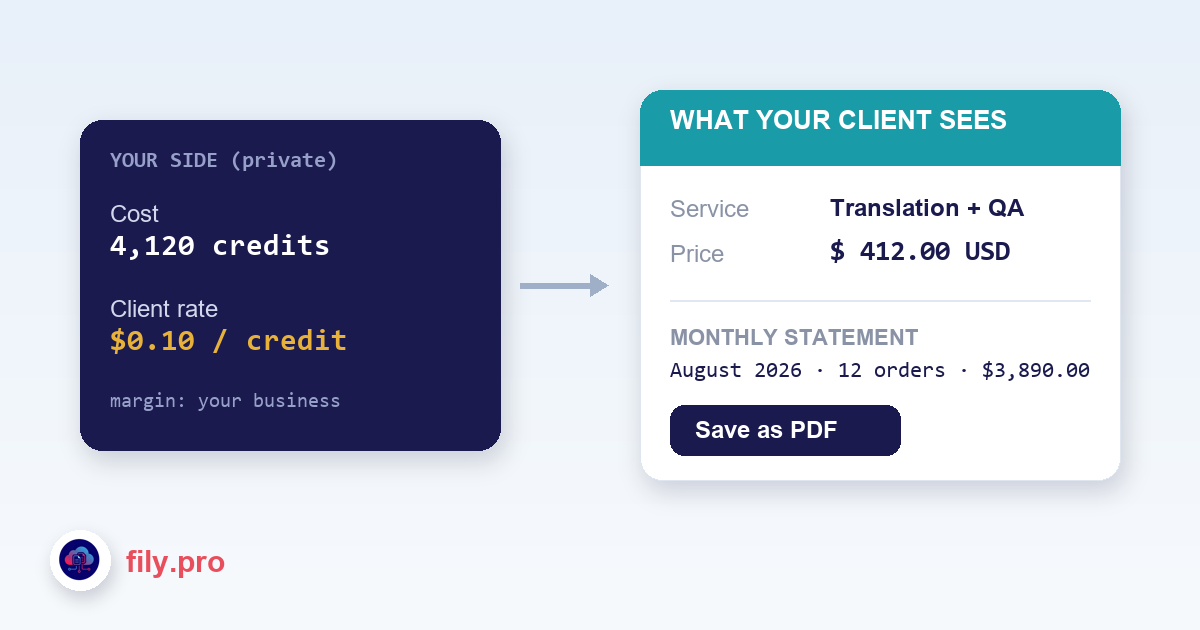
Most of our customers are not end clients. They are agencies and language teams who resell the work — and the first rule of reselling is that your client must never, under any circumstances, see your cost.
Until now the portal was carefully silent about money, which was the safe default and also not very useful. This week it learned to talk about money the right way: in your prices.
You set the rate, per client
You define your resale rate once, and override it per client where the relationship calls for it — the high-volume account with negotiated pricing, the rush-everything account that pays for the privilege. Each client gets their own number, managed in one place.
The client sees their price, in their currency
When a client places a request or opens their billing page, what they see is your price in their currency. Not credits, not internal units, not a hint of what the work costs you. The estimate they see at request time and the amount on their statement come from the same rate card, so there are no surprises to explain later.
Statements from what was charged, not what was estimated
The portal’s billing page is built from the ledger of what was actually charged — the same records our own accounting reads — never recomputed from estimates after the fact. Your client gets a monthly statement they can print or save as a PDF and attach straight to their own paperwork.
None of this required a billing integration, a spreadsheet export, or a Friday afternoon of copy-pasting numbers into invoices. You set a rate; the portal does the arithmetic and keeps the receipts. Your margin is your business — now literally.
Want this in your workflow? Try Fily with one file — no card, no demo form.